
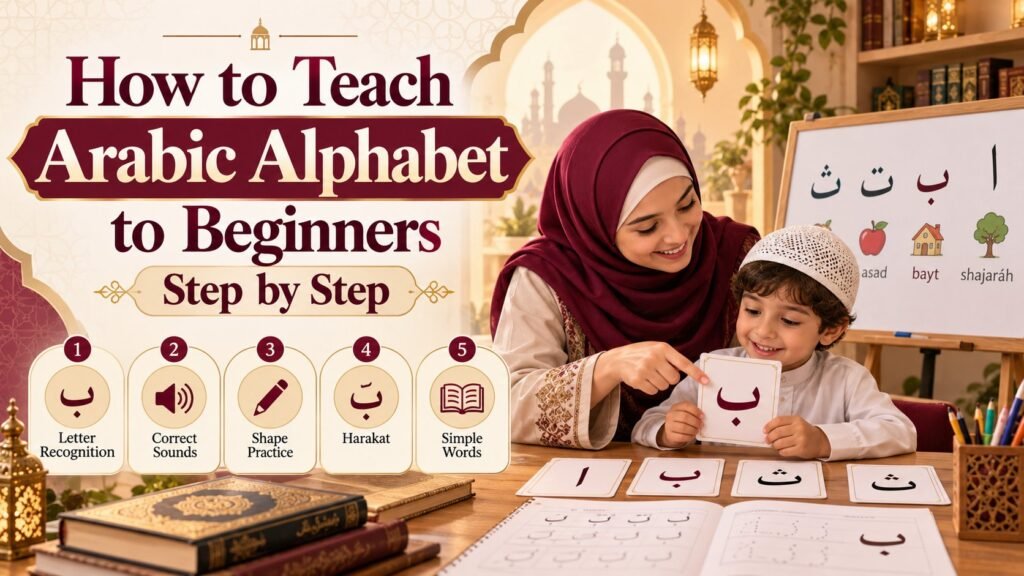
Learning the Arabic alphabet is the first step toward reading Arabic and beginning Quran education. For children, adults, and anyone starting from zero, understanding the letters, their sounds, and their shapes can build a strong foundation for future learning. However, learning Arabic is not only about memorizing letters. Beginners also need to understand how Arabic is written, how letters connect, and how vowel marks change their sounds. A step-by-step approach can make the learning process easier to follow and help students avoid common mistakes. At Online Quran Academy, We believe that beginners should learn at a comfortable pace, practise regularly, and focus on correct pronunciation from the beginning. Whether you are teaching your child at home or learning Arabic yourself, this guide explains how to teach the Arabic alphabet step by step.
Why is Learning the Arabic Alphabet Important?
The Arabic Alphabet is the foundation of Arabic reading. Students who want to read the Quran need to recognize Arabic letters and understand how they work together to form words. Learning the alphabet helps beginners:
- Recognize Arabic letters by their shapes.
- Understand the basic sounds of each letter.
- Identify the differences between letters with similar shapes.
- Read Arabic from right to left.
- Understand how letters connect within words.
- Begin reading simple Arabic words with vowel marks.
- Prepare for Quran reading and further Tajweed lessons.
Children and adults may learn at different speeds, so lessons should match the learner’s age, existing knowledge, and learning needs. Regular practice and clear feedback are more useful than rushing through the alphabet.
Step 1: Explain That Arabic Is Written From Right to Left
Before teaching individual letters, explain how Arabic writing works. Unlike English, Arabic is written and read from right to left. Beginners should become familiar with this direction before moving on to longer words or sentences.
How to teach this step:
- Show the learner a simple Arabic alphabet chart.
- Point to the first letter on the right side.
- Demonstrate how to follow a line from right to left.
- Ask the learner to trace the direction with a finger.
- Practise reading short examples from right to left.
Keep this activity simple. Young children may benefit from large printed letters, colorful cards, and tracing exercises. Adults may prefer a notebook and a clear alphabet chart. The goal is to make the writing direction familiar before introducing more complicated reading tasks.
Step 2: Introduce the 28 Arabic Letters
The Arabic alphabet has 28 standard letters. Teach the letters in small groups instead of expecting a beginner to memorize the entire alphabet in one lesson. Here is the standard Arabic alphabet:
ا ب ت ث ج ح خ د ذ ر ز س ش ص ض ط ظ ع غ ف ق ك ل م ن ه و ي
Start with a few letters and make sure the learner can recognize them before introducing more.
For example, you can begin with:
- ا — Alif
- ب — Ba
- ت — Ta
- ث — Tha
Show each letter clearly, say its name, and demonstrate its sound. Ask the learner to repeat the name and sound while looking at the letter. Avoid relying entirely on English transliteration. Some Arabic sounds do not have exact English equivalents, and written approximations cannot fully explain how every letter should be pronounced.
Step 3: Teach Letters With Similar Shapes Together
One challenge for Arabic beginners is that several letters look similar. They often share the same basic shape but have different dots. For Example:
| Arabic letters | Main difference |
|---|---|
| ب ت ث | One dot below, two dots above, and three dots above |
| ج ح خ | A dot below, no dot, and a dot above |
| د ذ | No dot and one dot above |
| ر ز | No dot and one dot above |
| س ش | No dots and three dots above |
| ص ض | No dot and one dot above |
| ط ظ | No dot and one dot above |
| ع غ | No dot and one dot above |
Use these groups to help learners notice the details that distinguish one letter from another.
Practice activity: Write three similar letters on a board or piece of paper. Say the name of one letter and ask the learner to point to it. Then switch roles and let the learner identify each letter. Repeat the activity with different letters until the learner can recognize them without guessing. Pay special attention to dot placement. A small visual difference can change the identity of an Arabic letter.
Step 4: Teach the Correct Pronunciation of Each Letter
Recognizing a letter is only one part of learning Arabic. Beginners also need to develop the ability to pronounce its sound correctly. Some Arabic letters may sound unfamiliar to people who speak English or Bengali. For example, ح and ه are different letters, as are س and ص. English spelling alone cannot accurately represent every Arabic sound.
Follow these teaching methods:
- Say the letter clearly.
- Let the learner listen carefully.
- Ask the learner to repeat the sound.
- Compare similar sounds when necessary.
- Give gentle corrections and allow time for practice.
For Quran Reading, pronunciation is particularly important because students need to learn the Arabic letters as they are recited, rather than relying only on approximate English sounds. Parents can use reliable audio resources for listening practice. However, a qualified Quran teacher can provide useful feedback when a learner struggles with a letter’s pronunciation or articulation. Do not expect perfect pronunciation immediately. Focus on steady improvement and correct errors before they become habits.
Step 5: Help Beginners Practise Writing Arabic Letters
Writing practice can help learners become more familiar with the shape and structure of each letter. Start with individual letters before asking the learner to write complete words.
A simple writing activity:
- Show one Arabic letter on a page.
- Ask the learner to trace the letter with a finger.
- Demonstrate how to write it with a pencil.
- Let the learner copy it several times.
- Compare the written letter with the original example.
For Children, tracing worksheets and large letter cards can make the activity easier. Adults may prefer lined paper and a printed alphabet chart. Remember that Arabic letters should be practised from the correct writing direction. Encourage the learner to pay attention to the main shape, dots, and position of the letter. Writing does not replace listening and speaking practice. Use it alongside letter recognition and pronunciation exercises.
Step 6: Teach How Arabic Letters Change Shape
After beginners become familiar with individual letters, introduce the way Arabic letters change shape when they appear in words. Many Arabic letters have different forms depending on whether they appear alone, at the beginning, in the middle, or at the end of a word.
These are commonly called:
- Isolated form
- Initial form
- Medial form
- Final form
For example, the letter ب can appear in different forms:
- Isolated: ب
- Initial: بـ
- Medial: ـبـ
- Final: ـب
The basic identity of the letter remains the same, even though its appearance changes. Teach a few examples at a time. Show the isolated letter beside its connected forms and ask the learner to identify what remains familiar. It is also important to explain that not all Arabic letters connect to the following letter. Six letters do not join to the letter immediately after them: ا، د، ذ، ر، ز، و. Understanding this rule helps beginners make sense of connected Arabic writing.
Step 7: Introduce Harakat (Arabic Vowel Marks)
Once learners can recognize the letters, introduce the basic short vowel marks, known as Harakat. The three fundamental short vowels are:
| Vowel mark | Arabic name | Example | Approximate sound |
|---|---|---|---|
| َ | Fathah | بَ | Ba |
| ِ | Kasrah | بِ | Bi |
| ُ | Dammah | بُ | Bu |
These examples show how the vowel marks affect the sound of the letter ب. Explain each mark separately before combining them in exercises. Ask the learner to read the examples aloud and listen carefully to the differences. As The learner becomes more confident, Introduce other marks and reading rules, including Sukoon, Shaddah, and Tanween. For Students preparing to read the Quran, it is helpful to follow a structured beginner’s primer, such as Noorani Qaida, with appropriate guidance. The order and pace should reflect the learner’s current level.
Step 8: Practise Joining Letters to Read Simple Words
When learners recognize individual letters, understand their connected forms, and read basic vowel marks, they can begin practising short Arabic combinations. Start with simple examples using letters and vowel marks the learner already knows. Demonstrate how to identify each letter, read its sound, and combine the sounds carefully.
Teach the learner to:
- Identify each letter in the combination.
- Notice the dots and connected forms.
- Recognize the vowel marks.
- Pronounce the sounds in the correct order.
- Read the complete combination slowly.
Avoid encouraging learners to guess a word from its overall appearance. Help them identify the letters and vowel marks instead. For Quran Learners, Choose examples from an appropriate beginner’s learning resource and check pronunciation with a qualified teacher. Progress to Quranic words and verses only when the learner is ready.
Step 9: Create a Simple Daily Practice Routine
Regular practice helps beginners review what they have learned and recognize letters more confidently over time. You do not need to make every lesson long. A short, focused session can work well when it includes revision, new learning, and feedback. Here is an example of a 15-minute practice routine:
| Activity | Time |
|---|---|
| Review previously learned letters | 3 minutes |
| Learn or revise new letter sounds | 4 minutes |
| Practise writing or tracing | 3 minutes |
| Read letters with vowel marks | 3 minutes |
| Review difficult letters | 2 minutes |
This is a suggested routine, not a fixed rule. Younger children may need shorter activities, while some adult learners may prefer longer sessions. If a learner repeatedly confuses certain letters, spend more time reviewing them before introducing additional material.
Step 10: Use Suitable Learning Materials
The right learning materials can make Arabic lessons more organized and easier to follow. Consider using the following resources:
Arabic alphabet charts: These help learners recognize letters and compare similar shapes.
Flashcards: Cards allow parents and teachers to test letter recognition through short, interactive activities.
Tracing worksheets: These support handwriting practice and help learners become familiar with letter shapes.
Audio lessons: Listening to accurate Arabic pronunciation helps learners understand sounds that may be unfamiliar.
Noorani Qaida: This beginner’s primer is commonly used in Quran education to introduce letters, vowel marks, and early reading skills in a structured sequence.
Guided online lessons: Online classes can provide explanations, listening practice and feedback from a Teacher, Depending on the course format. Choose Resources that suit the learner’s age and level. For Quran learning, prioritize materials that teach correct pronunciation rather than depending entirely on transliteration.
Common Mistakes to Avoid When Teaching The Arabic Alphabet
Beginners may find certain parts of Arabic difficult at first. The following teaching mistakes are worth avoiding.
1. Teaching Too Many Letters at Once
Introducing too many unfamiliar letters can make lessons confusing. Teach a manageable group and review it before moving forward.
2. Ignoring Pronunciation
Memorizing a letter’s name does not automatically mean the learner can pronounce it correctly. Include listening and speaking practice from the beginning.
3. Ignoring the Dots
Several Arabic letters share similar shapes. Teach learners to check the number and position of dots instead of guessing.
4. Teaching Only Isolated Letters
Students also need to recognize letters in their connected forms. Introduce these forms gradually once the individual letters are familiar.
5. Rushing Through Vowel Marks
Vowel marks influence pronunciation. Give learners enough time to distinguish Fathah, Kasrah, and Dammah before adding more complex rules.
6. Skipping Revision
Moving to new material without reviewing earlier lessons may leave gaps in understanding. Begin each session with a short review.
7. Comparing Every Learner With the Same Timeline
Children and adults have different learning needs. Some learners need extra time with pronunciation, while others need more practice recognizing connected letters. Adjust the teaching approach according to individual progress.
How Long Does It Take to Learn the Arabic Alphabet?
There is no single timeline that applies to every beginner. The time needed depends on factors such as age, practice frequency, previous experience, lesson quality, and pronunciation difficulties. Some learners may recognize many individual letters after a short period of regular practice. Reading connected Arabic text and applying vowel marks usually requires additional learning and revision. It is useful to measure progress through practical skills rather than a fixed number of days. For Example, Check whether the learner can:
- Recognize the letters in random order.
- Distinguish letters with similar shapes.
- Recall the basic sounds of the letters.
- Identify letters in their connected forms.
- Read simple combinations with vowel marks.
- Recognize and correct previously learned mistakes.
Once the learner demonstrates these skills consistently, you can gradually introduce more advanced reading exercises.
Should Beginners Learn Arabic Online or With a Teacher?
Both self-study and teacher-guided learning can support beginners, but they offer different benefits. Self-study materials, alphabet charts, and audio lessons allow learners to practise at their own pace. They can be useful for reviewing familiar letters and completing simple exercises. A Teacher can demonstrate pronunciation, identify mistakes, answer questions, and adapt lessons to the learner’s needs. This support is particularly useful for children and for students learning Arabic to read the Quran correctly. Online lessons may combine the convenience of learning at home with teacher guidance. Their usefulness depends on the teaching method, lesson structure, and opportunities for the student to practise and receive feedback. For Quran Beginners, A Structured learning path that includes letter recognition, pronunciation, connected forms, and vowel marks can help organize the learning process.
How Online Quran Academy Can Support Beginner Quran Learning
Online Quran Academy provides Quran learning resources and courses for students at different stages of their learning journey. Beginners who want to build their Arabic Reading Foundation can explore The Noorani Qaida course to learn about the basic skills needed for Quran Reading. As their skills develop, students can consider further learning in Quran reading with Tajweed and other available courses. A suitable course should match the learner’s current ability, learning goals, and preferred pace. Before beginning, parents and adult students should review the course details and ask any questions they have about lesson structure, teacher guidance, and learning expectations. Our Goal is to help learners understand the steps involved in Quran education and choose a learning path that fits their needs.
Frequently Asked Questions
1. How do you Teach the Arabic alphabet to beginners?
Start by explaining that Arabic is written from right to left. Introduce the letters in small groups, teach their names and sounds, and use activities to practise recognizing similar shapes. Once learners are familiar with individual letters, introduce connected forms and vowel marks.
2. How many letters are in the Arabic alphabet?
The standard Arabic alphabet contains 28 letters. Beginners should learn to recognize each letter, distinguish its shape from similar letters, and understand its basic pronunciation.
3. What is the best order for teaching Arabic letters?
A practical sequence is to introduce the writing direction, individual letters, letter sounds, similar letter shapes, writing practice, connected forms, and short vowel marks. The pace can be adjusted to suit the learner.
4. Can children learn the Arabic alphabet at home?
Yes. Parents can support learning at home with alphabet charts, flashcards, tracing activities, and reliable audio resources. For Quran reading, teacher guidance can help children develop more accurate pronunciation and identify mistakes.
5. Can adults learn the Arabic alphabet from scratch?
Yes. Adults can begin with the individual letters and gradually move toward connected forms and basic reading exercises. Regular practice and a suitable learning plan can help adults build their skills without needing prior Arabic knowledge.
6. Is Noorani Qaida useful for learning the Arabic alphabet?
Noorani Qaida is a commonly used beginner’s resource in Quran education. It introduces foundational reading skills, including Arabic letters and vowel marks, and can help organize early Quran learning when used appropriately.
7. Why is Arabic pronunciation difficult for some beginners?
Some Arabic sounds do not have direct equivalents in a learner’s first language. Differences in articulation and similar-sounding letters can make pronunciation challenging. Listening carefully, practising regularly and receiving feedback from a qualified teacher can help address these difficulties.
8. When should a beginner start reading the Quran?
A learner can begin appropriate Quran reading exercises after developing the necessary letter recognition and pronunciation skills. The next step depends on the learner’s readiness and ability to apply connected forms and vowel marks. A qualified Quran teacher can help determine when to progress.
Conclusion
Teaching the Arabic alphabet to beginners becomes more manageable when lessons follow a clear sequence. Start with the writing direction and individual letters, then introduce pronunciation, similar letter shapes, connected forms, and vowel marks. Regular revision and appropriate feedback can help learners build a strong foundation. Whether you are teaching a child at home or starting your own Quran learning journey, remember that every learner progresses at a different pace. Focus on understanding and correct pronunciation rather than rushing through lessons. If you are ready to continue learning, explore the available courses at Online Quran Academy and choose a learning path that suits your current level and goals.